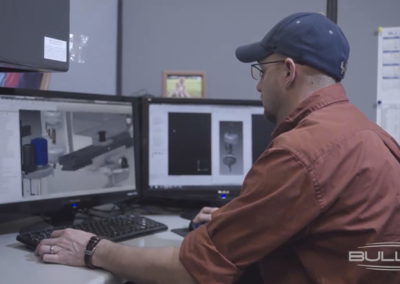
Robotics in Modern Machining
Across the manufacturing industry, robotics has become an everyday part of how precision parts are made. Today’s machining environments are increasingly defined by automation with robotic arms tending machines, autonomous systems loading and unloading parts, and smart sensors collecting data in real time. As materials get more advanced and tolerances get tighter, robotics isn’t just a productivity booster; it’s becoming a critical part of how manufacturers keep processes consistent, safe, and scalable.
Robots excel at repetitive tasks that demand consistency, enabling skilled operators to focus on higher-level work. Plus, facilities that have the ability to digitally play through production or trade feedback across the plant through sensors and AI analysis, there is a potential for real time improvements to systems.
How Robotics Enhances Ultrasonic Machining at Bullen
At Bullen, robotics isn’t a futuristic concept – it’s a practical tool that keeps our ultrasonic machining operations running smoothly, safely, and efficiently. One example is the robotic cell our engineering team designed around an industrial robotic arm. While we didn’t manufacture or modify the arm itself, we did create custom end-of-arm tooling (EOA) tailored specifically for handling our customers’ parts and our ultrasonic tools.
What the Robotic Cell Actually Does
The robot performs what’s commonly known as machine tending (moving parts and ultrasonic tools into and out of our machines at exactly the right moment). This timing is critical in ultrasonic machining, where maintaining consistent utilization has a big impact on throughput and scheduling.
Instead of an operator manually loading and unloading heavy or sharp tooling, the robot takes over these steps with reliable speed and consistency. That’s where its value really shines:
- Efficiency: The cell keeps machines running with fewer pauses, increasing total utilization.
- Safety: Our ultrasonic tools can be heavy and sharp. Automating the transfer reduces ergonomic strain and risk for our team.
- Repeatability: While accuracy and precision improvements are complex topics in robotics, increased process repeatability supports more predictable machining outcomes.
Do We Use It as a Customer-Facing Solution?
Rather than offering the robotic cell as a standalone product, we use it to enhance the machining services we deliver. Customers benefit from faster turnaround, improved consistency, and the ability for Bullen to handle higher-volume production more efficiently.
When Robotics Makes Sense in a Machining Environment
Robotic components aren’t necessary for every machining challenge, but they’re ideal in several scenarios:
- High-volume production with a limited variety of part configurations
- Heavy or awkward tooling that poses risks for operators
- Operations requiring consistent machine-tending cycles, where robotic timing can outperform manual loading
- Processes that benefit from predictable throughput, ensuring machines stay active instead of idle
Robotic cells like ours shine when production volumes increase or when part configurations remain relatively consistent. They’re also ideal when tooling is heavy or hazardous to handle, or when 24/7 uptime is critical. In these scenarios, robots aren’t replacing craftsmanship—they’re enabling it by taking over tasks that are better suited for automation.
Where AI Fits Into the Bigger Picture
As AI continues to advance within manufacturing, it’s becoming the invisible partner behind robotics. While our current robotic cell operates on preset commands and is not AI-driven, there is potential to operate within a broader landscape where AI continues to expand possibilities by pairing the machining cell with intelligence software. The current trend across the industry to continue to optimize and improve lines that already run great is to integrate into Industry 4.0 and connect the entire facility as one automated ecosystem where people, machines, and data work together seamlessly. AI will be intaking information from as much of the process as possible so that it can learn how all the inputs and outputs of each step in the process impact quality and efficiency of manufacturing the customer part.
AI capabilities are increasingly shaping how machining processes are optimized, such as:
- Predictive maintenance for manufacturing system and machine-tool components
- Adaptive scheduling based on real-time machine utilization
- Vision systems that classify or inspect parts on the fly
- Automated parameter tuning or job sequencing
AI will amplify robotic capabilities across the industry. When paired together, they enable smarter, safer, and more efficient machining environments.