Beyond the Model: Why Advanced Materials Machining Simulations Fail and How to Achieve First Part Correct Results
The Simulation-to-Reality Gap: Why Your Machining Models Fail
Advanced materials machining refers to the precision fabrication of hard, brittle substances like technical ceramics and glass using specialized techniques such as ultrasonic machining. This process utilizes high-frequency vibrations and abrasive slurries to remove material without inducing thermal stress or significant subsurface damage. Bridging the gap between digital simulations and physical production is critical to reducing R&D costs and ensuring high-precision component integrity. Understanding how to achieve first part correct results is essential for teams managing high-stakes projects.
Key Takeaways
- Advanced materials machining requires specialized techniques to avoid micro-fracturing and inconsistent tool wear in brittle substrates.
- Predictive modeling often fails for complex ceramics due to variations in density, internal stress, and granular microstructures.
- Engineering teams implement substitute materials during process validation to mitigate the financial risk of scrapping expensive prototypes.
- Achieving first part correct results relies on designing custom machine tools tailored specifically to unique part geometries.
- High-stakes industries like aerospace demand in-process metrology, comprehensive inspection, and rigorous certifications like AS9100 for quality assurance.
As a company specializing in advanced materials machining, we observe the challenges businesses face when transitioning ceramic components from design to production. Standard machining simulation models often fail to predict micro-fracturing, sub-surface damage, or inconsistent tool wear in brittle materials. That gap leaves teams searching for solutions as their prototypes fail, projects are delayed, and more money is thrown into the R&D budget to figure it out.
Predictive modeling is particularly difficult for advanced ceramics and custom hybrid materials due to their unique physical properties. Unlike homogenous metals, advanced ceramics have changes in density, granular microstructures, internal stresses, and varying hardness that are difficult to model accurately due to differing material removal characteristics. Plus, they can be expensive. Which means the more you have to test to get it right, the more your spending increases.
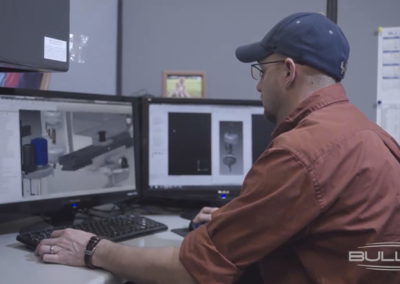
Simulations are a great starting point, and accuracy continues to grow as digital twins are developed, physics informed AI can be utilized, and machine data is collected and analyzed by systems in real time. However, not everyone can flip a switch and have all the tools for a perfectly connected factory. Especially start-ups, early prototyping, or new, custom materials are used.
It is important to review the systems at your disposal and plan a more robust validation strategy.
The ‘First Part Correct’ Framework: How Data-Driven Validation Improves Advanced Materials Machining
Traditional trial-and-error R&D or prototyping is inefficient, expensive, and provides little data to be reused, especially when working with challenging and unique materials. Teams constantly go back to the beginning and start over, carefully planning each iteration, hoping the next one will be right.
At Bullen, we work on the fail fast, fail forward approach with our early engineering. Not meaning that we like to fail but meaning that we quickly explore many approaches and rapidly narrow down what will work best. Our favorite projects are the ones that come to us in the initial stages of development where we get to work alongside our customer’s teams to design the entire production system around their unique parts and materials.
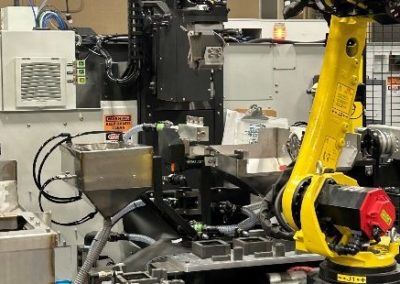
Our R&D department aims to get the first part correct. You may have heard of this referred to at other companies or in other industries in terms like “first pass yield” or “First Time Right.” It is a term used to indicate that we are careful to ensure the customer’s first part is correct. A key to how we get this right: designing our machine tools specifically for our customers’ parts. Then, instead of testing their material directly right away, we may utilize substitute material. Test cuts on alternative materials are one of many techniques used to prevent failure happing on the customer’s part.
Substitute or surrogate materials are alternative substrates used in advanced materials machining to replicate the properties of expensive ceramics during process validation. It may seem like overkill in some situations, but it is common for us when we work so frequently with expensive material that is hard to work with and brittle. The slightest mistake takes you down the revision process repeatedly.
On top of that, we often work with hybrid or custom material where there may only be one prototype or sample, which means only one chance to get it right. Complex materials are often expensive and require creating complex part geometries with molds or forms to achieve the shape the material needs to hold prior to machining. Customers with these radical materials need a partner who can get the most out of early prototypes to accommodate for their own learning. So, a partner only requesting to work with the bare minimum, one part or one sample, is appealing.
Alternative test cut materials are selected based on their ability to replicate the mechanical properties of the target advanced ceramic while reducing the financial risk of scrapping expensive prototypes. That is then used as a stand-in material that closely replicates the part, so we can collect data on how the part will take the machining method or tool we are using. If we have an issue with our machine positioning, work holding, ultrasonic tool, or other, it is a way to make this failure much smaller than if we scrapped their only prototype.
Precision Benchmarks for Ceramic Components: Surface Finish, Tolerance, and Geometry Standards
When engineers specify advanced ceramic components, the tolerances and geometry requirements they put on paper must be achievable in practice — and not every machining process can deliver. Here’s what to look for when evaluating whether a supplier’s capabilities can actually meet your design intent.
- Why ceramics demand a different benchmark standard: the hardness and brittleness of advanced ceramics mean that achievable tolerances, surface finish, and geometry are fundamentally different from metals; a capable partner should be able to hold repeatable precision and at Bullen we can down to 0.001 across production runs, not just one-off samples.
- Minimum feature sizes and hole geometry: our feature sizes ranging from 0.008″ up to several inches are achievable depending on material and design; for your application, ask whether your supplier can hold the feature you need at the size you need — not just in soft materials.
- Aspect ratio as a real capability benchmark: this is one of the most telling metrics; aspect ratios up to 60-to-1 are achievable in glass and advanced ceramics at Bullen Ultrasonics, a threshold many competing processes simply cannot reach.
- Sidewall quality and geometry fidelity: vertical sidewalls matter in high-precision assemblies; unlike many competing laser and abrasive blasting processes, ultrasonic machining is able to provide vertical sidewalls and geometric capabilities not achievable through traditional machining, including rectangular features with corners approaching 90°
- Surface integrity and subsurface damage: ultrasonic drilling process is non-chemical, non-thermal, has no heat affected zone and therefore almost no depth of damage, which translates to a clean, reliable surface without the need for post-machining stress relief
- Material-specific capability breadth: the right supplier should demonstrate capability across the ceramic families relevant to your application. Bullen’s list includes alumina, aluminum nitride, boron carbide, silicon carbide, silicon nitride, zirconia, CMCs, sapphire, and more.
For transparent materials, a separate benchmark is set: if your design involves glass or quartz, micron-level tolerancing, superior yields, and high throughput, it may be a better fit for proprietary laser processes like Bullen’s MicroLucent®. Depending on feature size, we can machine down to Ø 30µm, with tolerances as low as as low as ±10µm (±.0004″), and minimal local flatness impact around all features. Our laser process is non-electrical, has no HAZ (heat affected zone) or laser slag, gives straight sidewalls, and has zero DOD (depth of damage).
Essential Quality Control Processes for Advanced Ceramics Machining in Aerospace Manufacturing
In high stakes industries, stringent quality control is necessary. It is not just about company reputation or reviews; it is about lives at stake for the things you produce. For aerospace, defense, and medical components, part failure is not an option. Quality cannot simply be inspected at the end; it must be built into the entire machining process.
A qualified supplier must demonstrate:
- In-process metrology
- Comprehensive post-process inspection
- Full traceability
If you are reviewing suppliers, consider choosing someone with highly regulated certifications like the widely known QMS’s (quality management system) ISO 9001, industry specific standards like aviation, space, and defense’s AS9100 certification, ISO 9001, or automotive’s IATF 16949.
Summary: This section answers the critical need for stringent QC in high-stakes industries and addresses the related query about supplier selection. It defines the essential quality processes that qualify a machining partner for mission-critical components, positioning a supplier with these capabilities (like Bullen) as the ideal choice.
Criteria for Selecting an Ultrasonic Machining Partner for Advanced Ceramics Fabrication
When you are wondering “Who is the best partner for advanced machining of high value, hard, brittle components?” The best answer is to do your research. Not every supplier or shop will machine all materials, some may not have R&D departments, and many may use pre-built machines and tools which will all minimize customization options.
Use the QC process and vetting recommendations found above in your evaluation checklist. Plus, ask potential partners to provide documentation of their process validation framework and traceability procedures. A partner who can prove their data-driven approach is a partner who can mitigate risk and get you where you that first part correct. By prioritizing these steps, you learn how to achieve first part correct results in complex manufacturing environments.
Finally, ask questions. One supplier may seem more expensive than others or may have a higher up-front cost but look at the final bottom line. Are you comparing apples to apples? You need the detail to differentiate if one company has quoted based on standard machines and practices which gave a more stable cost throughout the project while another quote included R&D and custom tooling to get you as much precision as possible and reduce your end cost to produce.
Have an advanced machining need for a unique material? Reach out to our sales engineers to see if Bullen is a good fit.
Frequently Asked Questions
What is the primary cause of machining simulation failure?
Standard machining simulation models often fail to predict micro-fracturing, sub-surface damage, or inconsistent tool wear in brittle materials. These models struggle with the unique physical properties of advanced ceramics, such as varying density and internal stress, which differ significantly from homogenous metals used in traditional manufacturing simulations.
Why use substitute materials during the validation process?
Substitute materials serve as surrogate substrates to replicate the mechanical properties of expensive, brittle ceramics during process validation. This technique allows engineering teams to collect data on machining methods without the financial risk of scrapping a single, high-value prototype, which is critical for complex, custom material projects.
How to achieve first part correct results in manufacturing?
To achieve first part correct results, companies must design custom machine tools specifically for the customer’s unique part geometries. This data-driven framework includes utilizing substitute materials for test cuts, implementing in-process metrology, and maintaining rigorous traceability to ensure high-precision component integrity from the very first production cycle.
What certifications should a machining partner possess?
A qualified machining partner should demonstrate adherence to highly regulated certifications such as ISO 9001 for general quality management systems. For mission-critical industries like aerospace and defense, suppliers must also hold specialized standards like AS9100 to ensure that quality is built into the entire machining process rather than just inspected.