Maximizing Precision Ultrasonic Machining Efficiency With How Overall Equipment Effectiveness Optimizes Manufacturing Efficiency
How Overall Equipment Effectiveness (OEE) Optimizes Capital Utilization in Advanced Materials Machining
Overall Equipment Effectiveness (OEE) is a standardized performance metric used to evaluate how effectively a manufacturing operation is utilized compared to its full potential. In advanced materials machining, OEE measures the percentage of manufacturing time that is truly productive by accounting for equipment availability, performance efficiency, and output quality. By providing a clear data point for continuous improvement, OEE helps manufacturers determine whether to optimize existing assets or invest in new capital equipment. Understanding how overall equipment effectiveness optimizes manufacturing efficiency allows companies to maximize their production output and capital returns.
Key Takeaways
- OEE is a critical metric measuring availability, performance, and quality to assess total manufacturing productivity and identify production losses.
- Tracking OEE based on full machine capacity is essential for accurate future equipment planning needs.
- Real-time monitoring and data integration are vital for identifying machine performance issues and reducing downtime.
- Integrating artificial intelligence with OEE metrics enables predictive maintenance and proactive factory floor process improvements.
Defining the Three Pillars of Overall Equipment Effectiveness (OEE)
When tracking continuous improvement and trying to maximize floor efficiency, OEE (overall equipment effectiveness) is an indicator of how well you are using your capital. OEE looks at 3 key factors:
- Availability: the ratio of actual machine run time versus scheduled production time.
- Performance: efficiency measured by identifying losses from idling, minor stops, and reduced operating speeds.
- Quality: the ratio of good parts produced compared to total parts, including those with defects.
Each is measured as a percentage, which contributes to an overall percentage, the OEE score. Machines need to be kept up and running. If there is down time, it goes against the score.
OEE helps identify six big losses at play when running machines:
- Breakdowns
- Set-ups
- Idling
- Minor stops
- Reduced speed
- Defects
Between tracking the OEE score and identifying losses during production tracking overall equipment effectiveness can help you know if you need to spend money to buy more capital.
Optimizing Micromachining Equipment Selection Through OEE Best Practices

Some companies may use OEE in different ways. Problems can arise when there’s a differentiation between the definition of the score – if a machine can make 1,000 parts a day but a customer only orders 500 and that was a dedicated machine, technically your score should be 50%, however many companies look at it and consider that since the machine was dedicated, it ran all 500 parts that were ordered for the day, so they then determine that the score should be a full 100%.
The problem with that is it tells you it could run that much, but it doesn’t help with the planning of equipment needs and capacity. If you are looking at your OEE and wondering how to plan for future needs, make sure to track OEE based on potential full capacity of the machine.
If you are in the market for micromachining equipment, look for:
- Minimal set ups and breakdowns (availability)
- Enables consistent high-speed operation (performance)
- Ensures high yields (quality)
Alternatively, look for a machining partner that tracks OEE and can communicate with you about their machine planning for your project. At Bullen, we track OEE and maintain rigorous quality standards and certifications (like AS9100 and ISO9001) so ensure we’re providing the best performance for our customers.
Do you have a project you need equipment for but want to consider working with a specialized partner instead? Reach out to one of our sales engineers to see if Bullen is a good fit for your project.
Real-Time OEE Monitoring in Advanced Hard Material Machining
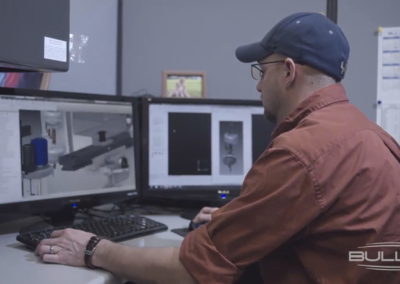
At Bullen, OEE data is captured directly from machining centers and coordinate measuring machines (CMMs), giving teams real-time visibility into both production performance and inspection results. An in-house dashboard translates this machine-integrated data into views of individual equipment performance while also tracking department-wide trends by day, week, and month. Because the dashboard updates continuously, teams can identify emerging losses and respond before they become larger constraints on capacity, throughput, or quality.
While artificial intelligence is not yet part of Bullen’s OEE dashboard, it represents a logical next step in our continuous improvement strategy. Bullen is exploring adaptive-learning capabilities within its machining centers to uncover recurring patterns, improve operating efficiency, and strengthen quality. Pairing these future insights with real-time OEE data could help teams anticipate performance issues and optimize the specialized processes used to machine demanding hard materials. This visibility also provides a practical framework for evaluating how different machining techniques perform in applications involving glass, quartz, and other complex materials.
The Future of OEE: Integrating Artificial Intelligence and Industry 5.0
OEE is not just a vanity metric or something to check off a box when evaluating if you should invest in a machine upgrade or to add to your capabilities. When used properly, OEE can measure machine and people performance issues to minimize machine downtime. It can flag patterns in losses from quality. When tracked continuously like this, it should provide data for improvement areas.
Looking to the future as OEE begins to be implemented facility wide at Bullen, we will work it into our Industry 5.0 factory. By doing this, we will be plugging OEE into automatic dashboards and using artificial intelligence to help measure and anticipate areas of improvement before they become a problem or affect our OEE score.
Frequently Asked Questions
What is the primary purpose of OEE in manufacturing?
Overall Equipment Effectiveness is a performance metric used to evaluate how effectively manufacturing operations are utilized. It measures productive time by accounting for availability, performance, and quality. Understanding how overall equipment effectiveness optimizes manufacturing efficiency allows companies to make data-driven decisions regarding capital investments and continuous process improvement.
How do the three pillars of OEE improve production?
The three pillars of OEE—availability, performance, and quality—help identify specific losses such as breakdowns, idling, and defects. By isolating these factors, manufacturers can target specific areas for improvement. This structured approach ensures that machines operate at their full potential, directly contributing to higher output and reduced operational costs.
Why should manufacturers track OEE against full potential capacity?
Tracking OEE based on a machine’s full potential capacity provides accurate data for future equipment planning. If manufacturers only track OEE against scheduled orders, they may miss capacity constraints. Using full capacity as a benchmark ensures that the data reflects true efficiency and informs necessary capital expenditure decisions.
How does artificial intelligence enhance future OEE strategies?
Artificial intelligence enhances OEE by integrating with automatic dashboards to provide real-time data analysis. This technology allows manufacturers to anticipate performance issues before they occur. By using AI to monitor OEE, companies can proactively address losses, minimize downtime, and achieve higher levels of efficiency within an Industry 5.0 framework.
– AJ Ganino
Director of Operations, Bullen Ultrasonics